Partly in honor of Ali Al-Bukhaiti's op-ed below, I have started a small project to document Houthi military operations. I am monitoring official Houthi media for claims of military actions specifically, and recording them on a weekly and monthly basis. Over the long term, this should give researchers a better idea of what the Houthis are up to and where (at least according to their own claims).
There's a lot of options for monitoring official Houthi media. Since the early 2015 Houthi coup/takeover in Sanaa, outlets previously run by the internationally recognized Yemeni government are now run by the Houthis - this includes Saba News Agency, the Yemen TV satellite channel, and others. In other words, the Houthis now run what used to be official state media in Yemen - and in a twist I just can't seem to get accustomed to, use the outlets to claim Houthi military achievements as those of "the Yemeni armed forces".
I could also monitor outlets owned or friendly to former president/Houthi ally Ali Abdullah Saleh, as these often promote Houthi successes too. However, I've found that the most consistent and comprehensive source of information on Houthi actions is Al-Masirah, the Houthis' TV channel and news network. They issue multiple bulletins each day, in various media formats (video, print, audio), so recording them all won't be an easy task.
The point of the tracker is two-fold. One, to gain an awareness of the military image Houthis aim to project to the region. Two, to stay abreast of military developments in Yemen, at least from the Houthi perspective.
I'm two weeks into the tracker thus far, and the Houthis have already claimed over 150 military operations in November. Most were in Yemen, but about a quarter of them took place in Saudi provinces of Najran, Asir, and Jizan.
Tuesday, November 14, 2017

Monday, October 23, 2017
Al-Bukhaiti: The West Sympathizes with Houthis Due to Lack of Reliable Information
Below is my full translation of Ali Al-Bukhaiti's 16 October column "The Forgotten Yemenis - Why Does the West Sympathize with the Houthis?".
In general, Westerners and non-Arabs view our region within one context only: oil. It's the only resource that caused our countries appear on the map of global interests. Without it, no one would even mention the countries of our region, for in multiple aspects, the social contribution of Arab countries to the world amounts to zero. The contributions of the Arab world don't even equal one thousandth of the scientific and technological achievements of Israel, for example.
That isn't the main subject of this article, but it allows a viewpoint from which to discuss the war in Yemen. For it's through this viewpoint - oil, and the Yemen war's impact petroleum markets - that the Western and non-Arab mind views the conflict in Yemen. They're concerned with the flow of oil, rather than the flow blood from Yemeni civilians.
I won't go into the details of the conflict and current news about Yemen, because that's not our subject here either, rather what concerns me is the Western view of the war in Yemen, and the reasons behind its sympathy for the Houthi movement. I'm not talking about the sympathy of officials/institutions because their interests are determined and there's no room for emotion when it comes to interests. I'm talking about the sympathy of individual people, including those who may have official titles - organizations, journalists, authors, academics, media outlets, think tanks, people within the decision-making circles of civil society - this is what I've seen throughout my various meetings and trips. This inevitable sympathy from this segment stems not from religion or sectarianism, and it has no relation to the reasons behind the inner conflict in the region, instead it stems from other things entirely that need to be considered.
After speaking to many people, it became clear to me that their sympathy stems from their view of the conflict in Yemen and its actors. Here lies the problem and the reasons behind this totally deficient opinion of the conflict. They view the war as between Saudi Arabia on one side, and between a Yemeni Shia minority, with limited support from Iran, on the other. There is a total absence of the Yemeni people and other local actors in the conflict, as they believe that these actors are just tools of Saudi Arabia and have a weak presence on the ground.
When Westerners compare the enormous Saudi and Emirati financial resources, powerful military strength, and vast Sunni population in the region, to the small Houthi minority, with its traditional weapons and limited support from abroad, they can't help but to sympathize with the Houthis.
Westerners neither study nor follow with any urgency Houthi oppresssion and gross violations that would allow proper classification of the group, for they are too busy tracking the crimes of [Saudi, US] Coalition planes against Yemeni civilians and are almost totally oblivious to Houthi actions. Coalition air strikes and technology create more buzz than the Katyusha rockets and traditional artillery that the Houthis use, which kill civilians just the same. The West isn't interested in documenting the violations of the Houthis - the Houthis have no large financial accounts, they have no investments, no ability to sign trade or arms deals, nothing that the West desires for which reports of these violations might provide leverage. The West isn't interested in observing and documenting the crimes of groups that have no wealth and no account balances, because there is no future gain in return for their efforts.
Even while the practices and violations of the Houthis have reached the level of terrorism, no light has been shed on them yet. Bombing the houses of opponents, raiding homes, assaulting children and women, in addition to imprisoning thousands in private prisons where some have died and others were executed. These are all terrorist acts which the Houthis have admitted committing, and practice openly daily - they film when they explode peoples' homes and take pride in it. With all of this, until today neither the Houthis or any of its offshoots have been added to any global terrorism lists, there still exists an official and a popular sympathy for them, and that sympathy springs from the fact that the Houthis, in part, are fighting the Saudis, and there is no love for Saudi Arabia in the eyes of the West.
The West doesn't realize that the Houthis have taken 17 million Yemenis hostage, that they commit the ugliest of crimes. Because Saudi Arabia is an actor in the conflict, all of the focus is on the kingdom. Given the criminal effects of their airstrikes, I'm not defending the Coalition nor the Saudis, but I am calling on the West to see that Yemenis are a people kidnapped by a criminal gang that uses us as human shields, violates our rights, and that seeks vast cultural, theological, and governmental changes. This is as it adjusts the ideologies and instruction of the civil service, both military and civilian. Years from now, there will exist in front of us a savage bloc/movement of those recruited as part of an agenda carried out upon the region.
There is no difference between the actions of Houthis, ISIS, or Al-Qaeda, all of which commit what the West would describe as terrorism, but because the Houthis don't threaten foreigners, specifically Westerners, no one is interested in tracking their crimes. No one has added them to any terrorist lists. Quite the opposite - there are those who consider the Houthis as allies against terrorism because they fight Al-Qaeda, ignoring the Yemeni population held hostage by Houthi actions. They also ignore that the rule of the sectarian Houthi group over wide areas of Yemen actually aids Al-Qaeda and other terrorist groups in the region, creating sympathy for them among Yemenis resistant to Houthi rule who view them as the strongest anti-Houthi force.
We must not neglect to mention the failures among Yemeni groups opposed to the Houthis. These groups have failed to convey the true face of the Houthis to the West - to think tanks, media outlets, terrorism-focused research organizations, activists, and decision-making circles - in an objective and professional manner. There are Yemeni failures here. Hadi's legitimacy is supported by a Coalition more interested in justifying its own mistakes/crimes than showcasing those of the Houthis, and for that reason it has lost its credibility. Saudi efforts in this regard can't be trusted for various reasons, the most important of which is the large imbalance in power between it and the Houthis, in addition to the fact that Coalition strikes create a lot of destruction and civilian death... this would make any Saudi effort to showcase Houthi crimes fail before it has even started, it would be waste of time and money.
In order for the Houthi image not to remain clean, its crimes forgotten and uninteresting to Western organizations, an independent and objective Yemeni group needs to be formed that can cover the lack of information available on the Houthis. To convey true facts about them, show the suffering of Yemenis under them, to send the message that the conflict in Yemen isn't between Saudi Arabia and the Houthis, but on a simple level it's between Yemenis and Houthis, and it started more than 13 years ago. Saudi participation is a consequence of the conflict, and not a cause of it. There is a whole people who oppose Houthi rule, and suffer havoc as a result.
If the Yemeni people continue to be absent from the equation, if the Yemen war continues to be viewed as a Saudi-Houthi conflict, if the world still doesn't hear about the terrorism of the Houthis, then this misunderstanding and stereotyping will stay, and the world will continue to sympathize with the Houthis.
I'm not looking to defend Saudi Arabia or the Coalition, but the existing view of the Houthis needs to be corrected so that people stop being enamored with them due to misunderstandings and lack of information. The West needs to understand that there are Shia terror groups, even those who claim to be Zaydis, and their extremism is no less than those of Sunni terror groups.
 |
| Ali Al-Bukhaiti, former Houthi spokesman |
That isn't the main subject of this article, but it allows a viewpoint from which to discuss the war in Yemen. For it's through this viewpoint - oil, and the Yemen war's impact petroleum markets - that the Western and non-Arab mind views the conflict in Yemen. They're concerned with the flow of oil, rather than the flow blood from Yemeni civilians.
I won't go into the details of the conflict and current news about Yemen, because that's not our subject here either, rather what concerns me is the Western view of the war in Yemen, and the reasons behind its sympathy for the Houthi movement. I'm not talking about the sympathy of officials/institutions because their interests are determined and there's no room for emotion when it comes to interests. I'm talking about the sympathy of individual people, including those who may have official titles - organizations, journalists, authors, academics, media outlets, think tanks, people within the decision-making circles of civil society - this is what I've seen throughout my various meetings and trips. This inevitable sympathy from this segment stems not from religion or sectarianism, and it has no relation to the reasons behind the inner conflict in the region, instead it stems from other things entirely that need to be considered.
After speaking to many people, it became clear to me that their sympathy stems from their view of the conflict in Yemen and its actors. Here lies the problem and the reasons behind this totally deficient opinion of the conflict. They view the war as between Saudi Arabia on one side, and between a Yemeni Shia minority, with limited support from Iran, on the other. There is a total absence of the Yemeni people and other local actors in the conflict, as they believe that these actors are just tools of Saudi Arabia and have a weak presence on the ground.
When Westerners compare the enormous Saudi and Emirati financial resources, powerful military strength, and vast Sunni population in the region, to the small Houthi minority, with its traditional weapons and limited support from abroad, they can't help but to sympathize with the Houthis.
Westerners neither study nor follow with any urgency Houthi oppresssion and gross violations that would allow proper classification of the group, for they are too busy tracking the crimes of [Saudi, US] Coalition planes against Yemeni civilians and are almost totally oblivious to Houthi actions. Coalition air strikes and technology create more buzz than the Katyusha rockets and traditional artillery that the Houthis use, which kill civilians just the same. The West isn't interested in documenting the violations of the Houthis - the Houthis have no large financial accounts, they have no investments, no ability to sign trade or arms deals, nothing that the West desires for which reports of these violations might provide leverage. The West isn't interested in observing and documenting the crimes of groups that have no wealth and no account balances, because there is no future gain in return for their efforts.
Even while the practices and violations of the Houthis have reached the level of terrorism, no light has been shed on them yet. Bombing the houses of opponents, raiding homes, assaulting children and women, in addition to imprisoning thousands in private prisons where some have died and others were executed. These are all terrorist acts which the Houthis have admitted committing, and practice openly daily - they film when they explode peoples' homes and take pride in it. With all of this, until today neither the Houthis or any of its offshoots have been added to any global terrorism lists, there still exists an official and a popular sympathy for them, and that sympathy springs from the fact that the Houthis, in part, are fighting the Saudis, and there is no love for Saudi Arabia in the eyes of the West.
The West doesn't realize that the Houthis have taken 17 million Yemenis hostage, that they commit the ugliest of crimes. Because Saudi Arabia is an actor in the conflict, all of the focus is on the kingdom. Given the criminal effects of their airstrikes, I'm not defending the Coalition nor the Saudis, but I am calling on the West to see that Yemenis are a people kidnapped by a criminal gang that uses us as human shields, violates our rights, and that seeks vast cultural, theological, and governmental changes. This is as it adjusts the ideologies and instruction of the civil service, both military and civilian. Years from now, there will exist in front of us a savage bloc/movement of those recruited as part of an agenda carried out upon the region.
There is no difference between the actions of Houthis, ISIS, or Al-Qaeda, all of which commit what the West would describe as terrorism, but because the Houthis don't threaten foreigners, specifically Westerners, no one is interested in tracking their crimes. No one has added them to any terrorist lists. Quite the opposite - there are those who consider the Houthis as allies against terrorism because they fight Al-Qaeda, ignoring the Yemeni population held hostage by Houthi actions. They also ignore that the rule of the sectarian Houthi group over wide areas of Yemen actually aids Al-Qaeda and other terrorist groups in the region, creating sympathy for them among Yemenis resistant to Houthi rule who view them as the strongest anti-Houthi force.
We must not neglect to mention the failures among Yemeni groups opposed to the Houthis. These groups have failed to convey the true face of the Houthis to the West - to think tanks, media outlets, terrorism-focused research organizations, activists, and decision-making circles - in an objective and professional manner. There are Yemeni failures here. Hadi's legitimacy is supported by a Coalition more interested in justifying its own mistakes/crimes than showcasing those of the Houthis, and for that reason it has lost its credibility. Saudi efforts in this regard can't be trusted for various reasons, the most important of which is the large imbalance in power between it and the Houthis, in addition to the fact that Coalition strikes create a lot of destruction and civilian death... this would make any Saudi effort to showcase Houthi crimes fail before it has even started, it would be waste of time and money.
In order for the Houthi image not to remain clean, its crimes forgotten and uninteresting to Western organizations, an independent and objective Yemeni group needs to be formed that can cover the lack of information available on the Houthis. To convey true facts about them, show the suffering of Yemenis under them, to send the message that the conflict in Yemen isn't between Saudi Arabia and the Houthis, but on a simple level it's between Yemenis and Houthis, and it started more than 13 years ago. Saudi participation is a consequence of the conflict, and not a cause of it. There is a whole people who oppose Houthi rule, and suffer havoc as a result.
If the Yemeni people continue to be absent from the equation, if the Yemen war continues to be viewed as a Saudi-Houthi conflict, if the world still doesn't hear about the terrorism of the Houthis, then this misunderstanding and stereotyping will stay, and the world will continue to sympathize with the Houthis.
I'm not looking to defend Saudi Arabia or the Coalition, but the existing view of the Houthis needs to be corrected so that people stop being enamored with them due to misunderstandings and lack of information. The West needs to understand that there are Shia terror groups, even those who claim to be Zaydis, and their extremism is no less than those of Sunni terror groups.
Friday, September 29, 2017
Free Arabic News Channels on YouTube

For those of us who need to watch Arabic news but don't want to pay for a subscription service or a satellite dish, YouTube comes to the rescue.
After some research, below is my list of Arabic news channels that stream for free on YouTube. If you've got a smart TV or a Roku/AppleTV/ChromeCast etc., you can watch these on your TV, just like normal channels, via the YouTube app.
- Al-Jazeera: Wasn't streaming free in the US until 3-4 months ago. Now it's free, awesome! A smart decision by Qatar, who should probably take any chance it can get to have its voice heard in the US. Streams live.
- Al-Jazeera Mubasher: Al-Jazeera's "live all the time" news channel. Streams live, of course.
- BBC Arabic: Not the most exciting channel, but dependably objective. Streams live.
- Al-Mayadeen: 24-7 news and commentary, follows the Iran-Asad axis. Reasonably entertaining coverage and shows. Streams live.
- Al-Arabiya: KSA-funded news, 24/7. Streams live.
- Ro2ya TV: Jordanian channel, younger feel, some news but mostly social commentary and young/hip documentary-ish shorts. Fun channel.
- Al-Manar: Hizbollah's channel. Mix of news and random programming. Entertaining to watch LH's point of view. Streams live
- CBC: Egyptian channel with random mix of shows and then some news. One of the few free Egyptian channels that has a reasonably functional stream. Streams live.
- Syria News: Syria's state TV channel. Not as entertaining as you think it would be. Was a lot better back during the first few years of the war. Streams live.
- KSA 1: Saudi's main station, if you're into it. I sometimes am. Along with it are the other KSA channels, namely Islamic ones. Al-Quran Al-Kareem; Al-Sunnah Al-Nabawiya;
- Al-Hayah: Egyptian channel, some news but also lots of shows. Good if you want to hear Egyptian.
- France 24 Arabic: Arabic news, French-funded. Streams live.
- Russia Today Arabic: Infamous, just as weird as the English channel. Streams live.
Thursday, September 28, 2017
Even Arab Leaders (Hadi included) Can't Speak Arabic
Mohamad Krishan knows a good Arabic speaker when he hears one. And since he is a veteran anchor for Al-Jazeera, I would trust his judgment.
In this op-ed, Krishan obliterates various Arab leaders for their poor Arabic skills. Starting with a discussion of a recent Tunisian governor's substandard French-language speech during a memorial in Nice, France, Krishan then compares the disastrous event to the amazing French skills of past Tunisian politicians like former president Habib Bourgiba and Hamadi Al-Said. These guys adopted the language of their colonizer. The next generation chose to focus on Arabic instead. The current generation of Arab leaders, Krishan says, can't speak either one on a professional level. It's an epidemic visible at any meeting that requires an exchange of words (rather than just a speech) and especially clear at any Arab League summit.
Yasser Arafat is the first among regional leaders to draw Krishan's wrath. He points out the (apparently memorable) error in Arafat's infamous "gun and olive branch" speech at the UN General Assembly in 1974. If the live interpreter hadn't corrected Arafat's grammatical mistake, the speech's most memorable clause would have lost its meaning.
But there is one national leader whose Arabic is so bad that it's even worse than Arafat's, Krishan says. It isn't even comparable (لا من قريب ولا من بعيد) to Arafat's level of badness. And that is Yemeni President Abd Rabo Mansoor Hadi. Krishan follows with this burn:
 Arab leaders from previous eras, people like Habib Bourgiba, Anwar Sadat, Houari Boemeddine, Hafez Al-Asad, and King Hussein of Jordan all had fantastic Arabic language skills. Whether reading from a speech or speaking spontaneously, their Arabic was high-level, Krishan says. With this current generation, their skill in Arabic is a reflection of their skills in governance - very poor.
 |
| Mohamad Krishan |
In this op-ed, Krishan obliterates various Arab leaders for their poor Arabic skills. Starting with a discussion of a recent Tunisian governor's substandard French-language speech during a memorial in Nice, France, Krishan then compares the disastrous event to the amazing French skills of past Tunisian politicians like former president Habib Bourgiba and Hamadi Al-Said. These guys adopted the language of their colonizer. The next generation chose to focus on Arabic instead. The current generation of Arab leaders, Krishan says, can't speak either one on a professional level. It's an epidemic visible at any meeting that requires an exchange of words (rather than just a speech) and especially clear at any Arab League summit.
Yasser Arafat is the first among regional leaders to draw Krishan's wrath. He points out the (apparently memorable) error in Arafat's infamous "gun and olive branch" speech at the UN General Assembly in 1974. If the live interpreter hadn't corrected Arafat's grammatical mistake, the speech's most memorable clause would have lost its meaning.
But there is one national leader whose Arabic is so bad that it's even worse than Arafat's, Krishan says. It isn't even comparable (لا من قريب ولا من بعيد) to Arafat's level of badness. And that is Yemeni President Abd Rabo Mansoor Hadi. Krishan follows with this burn:

Thursday, November 10, 2016
ما شاء الله, Arabic Trump Election Memes
A collection of the finest Trump election memes currently circulating on Arabic social media:
 |
| "Ivanka Trump, daughter of the new president. Looks like a Sheikha to me - fine offspring indeed." |
 | ||
| "Congrats on your Dad's victory" |
 | ||
| "Donald Trump's daughter. You guys want her father to lose? No way. We're all with Trump, all the way. Have a little sense!" |
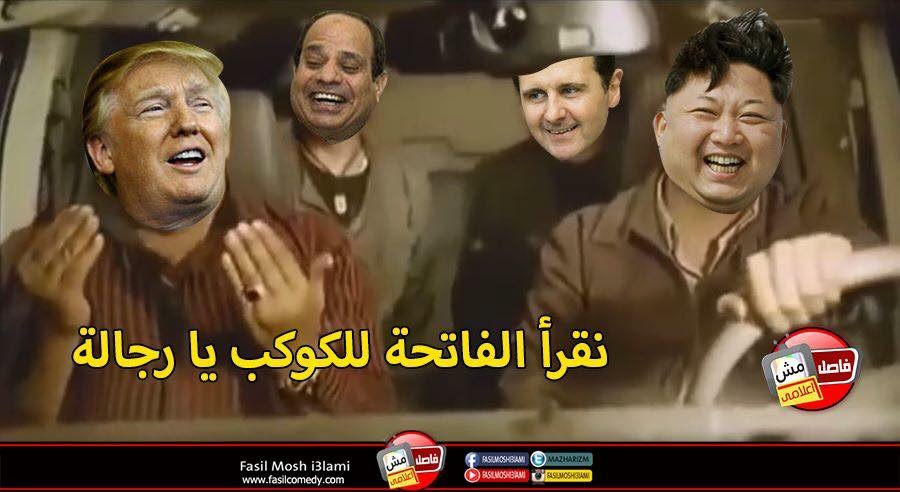 | ||
| "Guys, let's read the Fatiha for the whole planet"* |
 |
| "Happy from his win, Donald Trump does the call to prayer. Oh man, Subhan Allah" |
*admittedly bad translation.
Tuesday, November 8, 2016
الحشد / Iraq's PMF Shia Militia Win Film Festival In Cairo
 |
| Award won by PMF in Cairo (Credit:PMF website) |
Film making - not among most people's guesses for obvious talents of a brutally sectarian group of militias. However, they claim to have won awards for their documentary film about the origins of الحشد/Popular Mobilization Forces.
Al-Jazeera reported on the story yesterday, following up on a claim from the PMF's website announcing that they won the "Creativity Appreciation Award" for their documentary film explaining the origins and motivating factors behind the formation of the PMF. The prize was awarded at the Cairo Art & Media Contest (مونديال القاهرة للفن والاعلام), which is sponsored by the Arab League. The PMF also claim to have won a vaguely-worded "First Prize" award.
Of note is that the PMF's documentary also claims to expose "countries support Daesh... like those which have facilitated border crossings for the group."
Monday, October 17, 2016
Not a Good Sign for the Battle of Mosul
Seen on Twitter lately is a blatantly sectarian slogan used by some of the very groups participating in the Popular Mobilization Forces (الحشد الشعبي), the militia that cooperates closely with the Iraqi Army:

This slogan has lots of baggage, but basically the it infers that residents of Mosul can be considered descendants of those who killed Hussein and thus responsible for their actions. The literal translation is "Those descendants are from those ancestors." While blatantly sectarian rhetoric from the PMF is nothing new, such slogans do not bode well for the coming battle of Mosul. In the tweet above, the slogan is used by a sectarian Sunni on Twitter to mobilize sectarian sentiment against the PMF (and presumably Iraqi forces as well).
"هؤلاء الاحفاد من اولئك الاجداد"

This slogan has lots of baggage, but basically the it infers that residents of Mosul can be considered descendants of those who killed Hussein and thus responsible for their actions. The literal translation is "Those descendants are from those ancestors." While blatantly sectarian rhetoric from the PMF is nothing new, such slogans do not bode well for the coming battle of Mosul. In the tweet above, the slogan is used by a sectarian Sunni on Twitter to mobilize sectarian sentiment against the PMF (and presumably Iraqi forces as well).
Tuesday, April 21, 2015
Houthis + Iran? Houthi Buried Next to Hezbolla's Mughniyeh
There remains considerable debate regarding the strength of links between the Houthis and Iran. From our perspective, the fact that financial/military/ideological links are present is well established. However, how strong are those links? How much sway does Iran have over the Houthi movement?
From official Houthi social media (and any official Houthi statements, for that matter), they would have you believe that Iran has very little sway. Any links that exist are simply friendly and diplomatic - the Houthis are not part of some Iranian plot to extend its interests in the Arabian Peninsula.
This post won't offer a conclusion to that debate. However, we would like to shed light on a headline that may add fuel to the fire:
"Houthi Leader Buried Next to Imad Mughniyeh in Beirut"
Is this article true? That's unclear. It's from (somewhat tabloidish newspaper) Al-Quds Al-Arabi, who in the article cites a Lebanese website as saying that Houthi spiritual leader Abdel Malek Al-Shami was buried on April 12th in southern Beirut, next to the grave of notorious Hezbollah operative Imad Mughniyeh. Abdel Malek Al-Shami was a Houthi preacher killed in ISIS's 20 March bombings of two Houthi mosques in Sanaa.
Why is a Houthi leader being buried next to someone as important as Mughniyeh?
From official Houthi social media (and any official Houthi statements, for that matter), they would have you believe that Iran has very little sway. Any links that exist are simply friendly and diplomatic - the Houthis are not part of some Iranian plot to extend its interests in the Arabian Peninsula.
This post won't offer a conclusion to that debate. However, we would like to shed light on a headline that may add fuel to the fire:
 |
| Headline reads: "Houthi Leader Buried Next to Imad Mughniyeh in Beirut" |
Is this article true? That's unclear. It's from (somewhat tabloidish newspaper) Al-Quds Al-Arabi, who in the article cites a Lebanese website as saying that Houthi spiritual leader Abdel Malek Al-Shami was buried on April 12th in southern Beirut, next to the grave of notorious Hezbollah operative Imad Mughniyeh. Abdel Malek Al-Shami was a Houthi preacher killed in ISIS's 20 March bombings of two Houthi mosques in Sanaa.
Why is a Houthi leader being buried next to someone as important as Mughniyeh?
Wednesday, January 22, 2014
Promoting ISIL: Feeling the Wrath of Facebook Admins
Other than jihadis talking to eachother, it's not often that Yemenis discuss the intricacies of infighting between Syrian opposition groups. That infighting has been a huge topic as of late, most notably the clashes between Al-Qaeda's Islamic State of Iraq and the Levant (ISIL) with a number of groups under the Islamic Front - an umbrella organization of Islamist opposition fighting groups in Syria.
Today, however, we were witness to a fascinating interchange between diehard supporters of ISIL and an administrator from Syria's most popular revolutionary Facebook page. The exchange occurred on the Facebook page of Yemeni journalist Abdel Razaq Al-Jamal, who wrote a strongly-worded post praising ISIL and criticizing other opposition groups:
Needless to say, these are not exactly objective words. They are, however, pretty extreme... Al-Jamal is making a not-so-subtle verbal attack on the brigades of the Islamic Front, who have been battling ISIL forces for several weeks. Several Salafi-Jihadi groups fight under their umbrella, including Ahrar Al-Sham, whose leader was designated by Ayman Al-Zawahiri as one of Al-Qaeda's representatives in Syria. ISIL's recent vicious tactics against both fellow opposition groups and Syrian civilians led to criticism from the majority of hardcore idealogues of the Salafi-Jihadi world, including Abu Basir Al-Tartussi, Mohamad Al-Maqdisi. All of this criticism has been highly visible, taking the form of public videos, open letters, and press statements. In fact, this very point is what Sara Al-Idlibi, the administrator of the Syrian Revolution page, brings up when responding to Al-Jamal:
Interesting in Sara's comment is her use of the term "تنظيم البغدادي" or "organization of Al-Baghdadi", which indicates her refusal to address ISIL by it's somewhat dignified self-made name "Islamic State." These newer names for the group have been picking up steam online, especially since the recent infighting. Another name commonly seen is "Baghdadi's State" as compared to "Islamic State". After getting some responses from ISIL supporters on Al-Jamal's page, Sara responds again:
What's so fascinating about this whole exchange is that Al-Jamal usually never gets much blowback when discussing Al-Qaeda issues on his page (he usually mentions them in a subtly positive light). In this case, his overt praise for ISIL may have been stretching it a little bit... So much so that an actual administrator of Syria's most popular revolutionary Facebook page emerged to rebuke his supporters.
Today, however, we were witness to a fascinating interchange between diehard supporters of ISIL and an administrator from Syria's most popular revolutionary Facebook page. The exchange occurred on the Facebook page of Yemeni journalist Abdel Razaq Al-Jamal, who wrote a strongly-worded post praising ISIL and criticizing other opposition groups:
 | |||||
| Post reads: "Al-Jazeera uses the term "Islamic State of Iraq and the Levant" and not "Da'esh", but the channel shows what happens in Syria in this way: The opposition is fighting the Syrian regime, ISIL is fighting the opposition. But in reality, ISIL is the one being fought by America, Saudi Arabia, Iran, and those nations' tools in Syria, and among those tools are factions of the opposition." ("Da'esh" is a dismissive acronym used for the group by its detractors, and sometimes by just normal observers). |
Needless to say, these are not exactly objective words. They are, however, pretty extreme... Al-Jamal is making a not-so-subtle verbal attack on the brigades of the Islamic Front, who have been battling ISIL forces for several weeks. Several Salafi-Jihadi groups fight under their umbrella, including Ahrar Al-Sham, whose leader was designated by Ayman Al-Zawahiri as one of Al-Qaeda's representatives in Syria. ISIL's recent vicious tactics against both fellow opposition groups and Syrian civilians led to criticism from the majority of hardcore idealogues of the Salafi-Jihadi world, including Abu Basir Al-Tartussi, Mohamad Al-Maqdisi. All of this criticism has been highly visible, taking the form of public videos, open letters, and press statements. In fact, this very point is what Sara Al-Idlibi, the administrator of the Syrian Revolution page, brings up when responding to Al-Jamal:
 | ||
| Sara's comment: "Are the Al-Nusra Front, Ahrar Al-Sham, Jaysh Al-Islam, Lawa' Al-Tawhid, and Jaysh Al-Mujahideen [all Islamist, fairly radical fighting groups] all tools of America, if so, then who is on the right path then? Do Baghdadi and those with him think that they are solving everything? You are wrong Al-Jamal, and unfortunately Al-Qaeda's image had been distorted as a result of your support to the organization of Al-Baghdadi" |
Interesting in Sara's comment is her use of the term "تنظيم البغدادي" or "organization of Al-Baghdadi", which indicates her refusal to address ISIL by it's somewhat dignified self-made name "Islamic State." These newer names for the group have been picking up steam online, especially since the recent infighting. Another name commonly seen is "Baghdadi's State" as compared to "Islamic State". After getting some responses from ISIL supporters on Al-Jamal's page, Sara responds again:
 |
| Sara: "If, in your point of view, all Syrians who revolted against the regime prior to hearing of Baghdadi are collaborators/agents of 'Sahwas", criminals, and apostates, then what do you call Al-Zawahiri, Maqdisi, Abu Qatada, Al-Tarifi, and Qunaybi, etc. and others who criticized Baghdadi harshly - are they also apostates, have they also become 'Sahwas'? Please, think a little bit, it won't hurt you." (Here, 'Sahwa' refers to Sahwa or Awakening councils formed by US troops in Iraq, made up of local Sunni tribes who allied with US forces to fight Al-Qaeda. Since that time, al-Qaeda sympathizers often label any native group who opposes them as 'Sahwas') |
What's so fascinating about this whole exchange is that Al-Jamal usually never gets much blowback when discussing Al-Qaeda issues on his page (he usually mentions them in a subtly positive light). In this case, his overt praise for ISIL may have been stretching it a little bit... So much so that an actual administrator of Syria's most popular revolutionary Facebook page emerged to rebuke his supporters.
Tuesday, October 1, 2013
Qasem: No Jihad An-Nikah in Syria. Is this the end of it?
Faisal Al-Qasem: Le Monde Says No Jihad An-Nikah in Syria
جهاد النكاح غير موجود في سوريا
But that won't stop everyone on the forums from talking about it....
جهاد النكاح غير موجود في سوريا
But that won't stop everyone on the forums from talking about it....
Tuesday, April 16, 2013
Yemen's (Virtual) Revolution
Yemen's National Dialogue is Blossoming Online

Al Arabiya Institute for Studies - Michael May & Dr. Basimah Rowe
An integral factor in uprisings across the Middle East, the use of social media tools to mobilize citizens and rapidly share information has been widely documented in countries like Egypt and Tunisia. Much less attention has been paid to smaller, peripheral countries like Yemen, and with a reputation as a bastion of tribal conservatism and illiteracy, most may not have envisioned Yemen riding the rising tide of internet activism in the region. The prolific writing of Yemenis young and old, however, has ignited social media sites, giving the world a moment-by-moment, authentic picture of this momentous period in Yemeni history. In this revolution, there is no longer a need for polished media experts and pundits to pontificate on Yemeni political life – its people are doing the job for them. Those wanting to experience Yemenis’ revolutionary spirit need only to visit Facebook and Twitter, where thousands of users shed light on mindsets of Yemen’s diverse population, or Yemen’s discussion forums, where members discuss all facets of Yemeni politics, social, and military affairs.
Without a doubt, this phenomenon contrasts sharply with internet connectivity statistics released by the International Telecommunications Commission. In their reports, Yemen’s internet use per capita ranks among the lowest in the Arab world. Despite this ranking, Yemeni social media stands strong among its peers: activity on Yemen’s Facebook pages surpasses that of its more “plugged in” neighbors like Bahrain, Jordan, and the UAE. The Yemeni Council, a Yemen-focused discussion forum, is one of the most active discussion forums on the Arabic-language internet. Yemenis choose from a selection of different forums dedicated to the country’s tribes and provinces – a phenomenon unique to Yemen. Connectivity statistics prove that this media revolution doesn’t necessarily represent an increase in the number of internet users in the country, but rather an increase in the direct channeling of political attitudes and free expression of opinion previously absent in Yemen and much of the Arab world.
While political developments have paved the way for the resurgence of freedom of expression in Yemen, technological developments have allowed it to flourish. Learning from their Arab cousins, Yemenis are harnessing social media to communicate their views as never before. No event better illustrates this phenomenon than the advent of the National Dialogue Conference, which sparked a rise in activity across the Yemeni social media universe[i]. Throughout the opening weeks of the conference, Yemenis offered their opinions on every facet of the Dialogue’s progress.
Bringing together leaders from across Yemen’s fractured society, the National Dialogue is an ambitious initiative. The conference consists of nine working groups, each focusing on the issues most critical to Yemen’s future: The Southern question, the status of Saada province, national reconciliation, state building, good governance, the armed forces & security, independent & social issues, rights & freedoms, and national development. While few Yemenis would disagree that these issues represent the most difficult obstacles on the country’s path to progress, conversations from Yemeni social media paint a more detailed picture. In these discussions, the Southern question and Saada province, in addition to the conference’s lack of youth representation, emerge as the three main stumbling blocks most important to Yemenis online.
The Southern Question
Dialogue or no Dialogue, the relationship between Yemen’s north and south consistently generates the highest levels of discussion online. With a civil war and years of armed clashes between government forces and Southern separatists in the country’s rearview mirror, tension between these two formerly independent nations is as tangible in the virtual world as it is on the ground. One hub of such tension is the Yemeni Council, where users of every political affiliation follow the workings of the National Dialogue with intense focus. The southern question has dominated the site, especially among southerners themselves, who often point out their passionate rejection of any southerner participating in the conference. These users claim that southern participants are “oblivious” to insincere government initiatives - “They’ve been bitten by the same snake, time and time again.” Most southern-focused discussion forums echoed such criticism, such as users on the Gates of the South, who listed names of what they called the “Gang of clones that will participate in the name southerners.” Not to be outdone, users on forums and Facebook pages affiliated with the separatist Southern Mobility Movement accused participants of colluding with the so-called Yemeni “occupation” regime, urging complete separation between the Yemeni government and southern provinces.The vast pessimism of many southern users toward Yemen’s intentions and its ability to solve the southern question contrasts with the views of conference participants, who seem optimistic that there is still plenty of time for progress to be made. In the closing statement of its first session, National Dialogue staff confirmed the importance of keeping “Doors of communication with all facets of the peaceful separatist movement open,” in addition to calling for the formation of additional mechanisms for greater communication. These statements may find welcome ears with the minority of southerners online who called for greater integration with the north. Their commentary offered an embrace of the Dialogue, pointing out the objective fact that injustices committed against the southerners deserve realistic and immediate solutions.
Youth Representation
Among Yemenis’ main
criticisms of the National Dialogue Conference is its perceived lack of
youth representation. At the start of proceedings, Dialogue Secretary
General Ahmad Bin Mubarak offered a hopeful explanation of the rationale
behind the distribution of seats at the conference. Mubarak noted that
50% of participants will hail from the north and 50% from the south;
among those, 30% will be female and 20% youth. Many Yemenis online
viewed these numbers as misleading: among the conference’s 565
delegates, independent youth activists were granted only
40 seats. The majority of the remaining seats were granted to blocs of
established political parties, some of which are linked to the shooting
deaths of innocent demonstrators during Yemen’s revolutionary protest
movement in 2011. Critics argue that despite their leadership at the
forefront of Yemen’s protest movement, independent youth activists are
underrepresented at the conference, leaving their voices to be drowned
out by those of more numerous and established political elites. One
place where youth voices are surely heard, however, is on Yemen’s
popular Facebook pages. Users on pages like the Second Page for Yemen’s Change Revolution and Yemen Eye News
were highly critical of the allotment of seats given to the independent
youth. The official page of Nobel laureate and youth activist Tawakkul
Karman, Yemen’s most followed Facebook page with over 370,000 “likes,”
mocked the proportion of independent youth represented at the Dialogue,
labeling it a “decoration” and urging UN envoy Jamal Benomar to admit
that the Dialogue falsely represented the revolutionary contributions of
youth activists. These youth-oriented pages’ sharp criticism of the
Dialogue’s seat distribution was praised by thousands of readers, but
with seventy percent of Facebook members in the Arab world aged 15 to
29, users on these pages have already created a dialogue of their own.
Saada Province
With
six wars fought against Yemeni government forces in the last ten years
and continuous calls for autonomy in Saada province, it should come as
no surprise that the actions of the rebel Houthi movement generate high
levels of conversation in Yemeni social media. Reflecting the increasing
sectarianism and anti-Iranian sentiment across the region, the Houthis’
role in Yemen is one of the most polarizing issues among Yemenis
online. The Houthi movement, known officially as Ansar Allah, operates a
sophisticated social media outreach program, including discussion
forums, a number of official Facebook pages, and pro-Houthi activists on
Twitter. While significant, these Houthi controlled outlets often act
as an echo chamber of pro-Houthi views - the place for real debate is
Yemen’s most popular Facebook page and discussion forum. The majority
of users on these sites diligently condemn the Houthis, citing
traditional grievances such as claims of Houthi collaboration with Iran,
assaults on fellow Yemenis, and sectarian arguments against an increase
in Houthi autonomy. Houthi users respond by condemning the Yemeni
government’s alliance with America and defending Houthi militant
operations as self-defense against an oppressive national government.
Despite the polarized rhetoric on both sides, however, there are reasons
for optimism: a growing minority of users articulates nuanced views on
the Saada issue. Many users on youth-oriented, pro-revolution Facebook
pages, for example, refuse to offer wholesale condemnation of the Houthi
movement, despite provocations from page administrators. Instead,
these users defend the Houthis’ right to express grievances at the
National Dialogue and criticize attempts to condone violence against them.Among Yemenis Online, Marginal Events Go Viral
There is little doubt that issues like the status of southern Yemen, Saada province, and adequate youth representation will dominate the National Dialogue for months to come. Observations online, however, prove that this may not be the case in the social media universe. From the first day of the conference, spikes in conversation demonstrated Yemenis’ rabid following of the National Dialogue down to the smallest remark. Often, the most popular subjects of conversation were those that reflected Yemen’s divisions, such as the expulsion of Huthi representative Ali Naser Al-Bukhaiti on the first day of the dialogue. Users even vigorously debated the word choice of Yemeni president Abd Rabo Mansur Hadi’s scolding of Al-Bukhaiti. Users were similarly divided when commenting on conference spokesperson Amal Al-Basha’s sharp confrontation with tribal chief Sadeq Al-Ahmar over the role of women in the conference. Other events early in the Dialogue created widespread agreement among users, perhaps offering hope for the future of the conference. Much of this consensus commentary centers around Yemenis’ desperate desire for the rule of law and their disdain for tribalism, such as when users swiftly condemned Yemeni strongman Sadeq Al-Ahmar’s assault on a Yemeni soldier, or when they lamented repeated attempts of tribal sheikhs to carry weapons into the Dialogue hall. Thankfully for Yemen, violence that threatens to derail the Dialogue, such as an assassination attempt on Houthi representatives, has also drawn the ire of the majority of Yemenis online.
Signs of Hope
Now that the first session of
Yemen’s National Dialogue has concluded, many followers of the
conference will no doubt claim that despite the vast effort, the
Dialogue has thus far accomplished little. The conference’s critics,
however, cannot deny the Dialogue’s one unprecedented achievement: a far
cry from bloody revolutions elsewhere in the region, Yemen’s feuding
factions have come together peacefully, under one roof, to acknowledge
the country’s problems and attempt to move past them. This monumental
accomplishment is being replicated online, where Yemenis prolifically
discuss the country’s most contentious topics. Despite their strong
disagreements on issues mentioned above, visitors to Yemen’s most
popular social media sites express their desire for lasting peace,
government reform, and an end to corruption.On a daily basis, Yemenis online are encouraging their fellow citizens to rise above traditional affiliations for the benefit of the country. Yemen’s challenges are immense, but if the sentiments of Yemenis online offer any reflection of the Dialogue participants themselves, there are strong reasons to be optimistic about the country’s future.
Tuesday, March 19, 2013
Unrest in Ma'an Connected to Emirates Royal Family
Is today's violence in Jordan's rambunctious city of Ma'an linked to the Emirati royal family?
So says Al-Quds Al-Arabi in an article today. So far, no English media have picked up on the connection. Here's the summary:
At dawn on Tuesday morning, clashes between the Special Branch of Jordanian General Security and wanted, armed men resulted in four dead and at least five injured. The Jordanian security services were looking for a man who was previously "wanted" for running over two of their officers with a car. This guy was apparently among two people who had overrun a military checkpoint last week. The attack led to the death of a Jordanian officer.
After the attack, authorities were able to catch one of the criminals, who was also injured. However, his friends were able to smuggle him out of the hospital. Jordanian forces pursued the man to a house where armed clashed broke out. Unable to get the man out, the Jordanians destroyed the home, killing the wanted man. The victim's relatives later clashed with security forces, leading to a heightened state of tension in the city that continues until now. The victim and his family are close to the ultraconservative Salafi community in Ma'an.
What's interesting is that, according to reports, the military checkpoint was guarding a road that leads to a large desert palace of Emirati royal and vice president Sheikh Mohamad bin Rashed Al-Maktoom.
 |
| Al-Quds Al-Arabi |
So says Al-Quds Al-Arabi in an article today. So far, no English media have picked up on the connection. Here's the summary:
At dawn on Tuesday morning, clashes between the Special Branch of Jordanian General Security and wanted, armed men resulted in four dead and at least five injured. The Jordanian security services were looking for a man who was previously "wanted" for running over two of their officers with a car. This guy was apparently among two people who had overrun a military checkpoint last week. The attack led to the death of a Jordanian officer.
After the attack, authorities were able to catch one of the criminals, who was also injured. However, his friends were able to smuggle him out of the hospital. Jordanian forces pursued the man to a house where armed clashed broke out. Unable to get the man out, the Jordanians destroyed the home, killing the wanted man. The victim's relatives later clashed with security forces, leading to a heightened state of tension in the city that continues until now. The victim and his family are close to the ultraconservative Salafi community in Ma'an.
What's interesting is that, according to reports, the military checkpoint was guarding a road that leads to a large desert palace of Emirati royal and vice president Sheikh Mohamad bin Rashed Al-Maktoom.
Thursday, February 14, 2013
American Mujahid in Syria
Whoa! The American mujahid in Syria is back!
This video is funnier than the last one. I found it on Facebook, posted yesterday on an extremist page.
We've seen him before in another YouTube video. This new video confirms that this guy is definitely not an Arabic speaker - his accent is way off. However, this video may prove that the guy is actually fighting with a brigade on the ground. Here, you can see him and his comrades riding up to what a crashed Syrian helicopter, what looks like an old Russian Hind model.
The kid is definitely having a good time. Money quotes:
"Smoke 'em!!"
"Suriya Jaysh, helicopter shot down!" (mix of Arabic and English, I personally find it hilarious)
"Every day, all day!"
What's also worth noting is that the other fighters are calling the American "Shishani," which means "Chechen" in English. He might be from a Chechen background, but I have also seen that term used to describe a generic, white, Western Muslim. Another is that he is wearing a Marine Corps Combat Utility Uniform, the current combat uniform worn by the United States Marine Corps. How did he get that shirt?
Check back for updates on this crazy American mujahid in Syria.
This video is funnier than the last one. I found it on Facebook, posted yesterday on an extremist page.
We've seen him before in another YouTube video. This new video confirms that this guy is definitely not an Arabic speaker - his accent is way off. However, this video may prove that the guy is actually fighting with a brigade on the ground. Here, you can see him and his comrades riding up to what a crashed Syrian helicopter, what looks like an old Russian Hind model.
The kid is definitely having a good time. Money quotes:
"Smoke 'em!!"
"Suriya Jaysh, helicopter shot down!" (mix of Arabic and English, I personally find it hilarious)
"Every day, all day!"
What's also worth noting is that the other fighters are calling the American "Shishani," which means "Chechen" in English. He might be from a Chechen background, but I have also seen that term used to describe a generic, white, Western Muslim. Another is that he is wearing a Marine Corps Combat Utility Uniform, the current combat uniform worn by the United States Marine Corps. How did he get that shirt?
Check back for updates on this crazy American mujahid in Syria.
Monday, January 28, 2013

Tuesday, January 22, 2013
Social Media and Getting Engaged
The cartoon below is a lot of fun:
 | ||||||
| Translation: "Give us a chance to ask about him in the forums and chat rooms that he goes to. After that, we'll answer you, God willing." |
Found this one on Ye1. The two men on the left are a father and son asking for the hand in marriage of the daughter of the man on the right.
Tuesday, September 18, 2012
Marines and Yemeni Paranoia
We have been absent for a while, but that doesn't mean that events haven't kept up their speed in the region. Speaking of events in the region, no one can forget this past week, when over a dozen American embassies were damaged by those protesting the anti-Islam movie "Innocence of Muslims." The embassies in Cairo and Sana'a were actually raided, and the consulate in Benghazi, Libya destroyed.
Following the raid last Thursday of the US embassy in Sana'a, Washington decided to send in some extra marines for security. Although some Yemenis think that only Yemen will receive some unwelcome American marines, their country is not the only one...in fact, extra security is being sent to other embassies in the region as well. Users on YE1, Yemen's biggest online forum, are freaking out about the marines, and they have been all weekend.
On the Yemen Revolution's Facebook page, people are also going nuts over the marines. Yesterday we saw a photo of a marine drill sergeant talking to some Yemeni uniformed personnel labeled "Photos of Marines' Arrival in Sana'a." Nevermind that the marines coming to Yemen would most likely never be wearing a drill sergeant hat, which is worn at book camp only (according to the movies we've seen?)...the ridiculous photo also included a backdrop of tall, green pine trees. Has anyone ever seen a tall pine forest in Sana'a, or anywhere in Yemen?
The facebook page has constant updates throughout the day, dozens in fact, so much that it's hard to follow. Today, this picture was posted:

The accompanying text reads:
"Sources: Sheraton hotel sold to the American embassy, First pictures of Marines in Sana'a. Sources revealed that dozens of American marines have spread around the embassy vicinity in the past few days."
According to Yemenis, Americans just bought one of Yemen's biggest and most important hotels.
Following the raid last Thursday of the US embassy in Sana'a, Washington decided to send in some extra marines for security. Although some Yemenis think that only Yemen will receive some unwelcome American marines, their country is not the only one...in fact, extra security is being sent to other embassies in the region as well. Users on YE1, Yemen's biggest online forum, are freaking out about the marines, and they have been all weekend.
On the Yemen Revolution's Facebook page, people are also going nuts over the marines. Yesterday we saw a photo of a marine drill sergeant talking to some Yemeni uniformed personnel labeled "Photos of Marines' Arrival in Sana'a." Nevermind that the marines coming to Yemen would most likely never be wearing a drill sergeant hat, which is worn at book camp only (according to the movies we've seen?)...the ridiculous photo also included a backdrop of tall, green pine trees. Has anyone ever seen a tall pine forest in Sana'a, or anywhere in Yemen?
The facebook page has constant updates throughout the day, dozens in fact, so much that it's hard to follow. Today, this picture was posted:

The accompanying text reads:
"Sources: Sheraton hotel sold to the American embassy, First pictures of Marines in Sana'a. Sources revealed that dozens of American marines have spread around the embassy vicinity in the past few days."
According to Yemenis, Americans just bought one of Yemen's biggest and most important hotels.
Wednesday, July 11, 2012
Arab Traveler and His Wife Hide Their Baby in Bag to Enter UAE
The منوعات / munawa3at (miscellaneous) section of Al-Quds Al-Arabi usually has some entertaining stories. You're trying to read the serious news, and you get distracted by some tantalizing story with a picture that steals your attention. This story is the perfect example:
A man and his wife tried to hide their baby inside a suitcase in order to get into the UAE. They were flying into Sharjah airport and didn't have a visa for their son. How old was the kid? 5 months old. The parents were arrested and charged with attempting to enter their son into the UAE illegally. In addition, the parents were charged with putting their son's life in danger (due the harmful effects of x-ray and metal detectors on infants). According to the story, the mother claimed that she agreed to put their baby in the suitcase only after her husband convinced her that it would not harm the baby.
As usual, the most interesting part of this story can be found in the comments section. Most of the commentors condemned what the parents did, but even more were quick to mention motivating factors. Almost all of the commentors criticized the UAE immigration authorities:
فعل شنيع حقا ولكن الاشنع منه تلك الدول التي تحولت الى اداة لظلم الاقارب ....ان يستصدر تاشيرة لحفيده وحتى الابن ايستطيع زيارة اهله المقيمين قبل ولادة وزير الداخلية او المسئول الذي يعتمد على المزاج في اتخاذ القرار.
- One noted : "An ugly act, but even uglier is are those countries that...give a visa to a grandson or the son, and their parents can't visit them, and it all depends on the mood of who is making the decision."
لماذا يحتاج هذا الطفل أو أبيه الى تأشيرة، أليس هو عربي. اذا كنت مقيم في اوروبا فلا تحتاج الى تأشيرة الى معظم دول اوروبا. أنا سافرت الى الأمارات قبل خمس سنوات وحصلت علي التأشيرة في المطار لأني أحمل الجنسية الألمانية ولم تكن معي جنسيتي الأصلية- الفلسطينية
- Another noted: "Why does the kid need a visa to visit, isn't he an Arab? If you live in Europe you don't need a visa for most of the European countries. I traveled to the Emirates 5 months ago and got a visa at the airport because I have German citizenship, and I didn't present my original citizenship, which is Palestinian."
هذا الرجل قام بهذا العمل بسبب قسوة قوانين دول الخليج و نظام الكفاله الجائر فيها .لو ان الانسان له حقوقه في تلك اللمالك لما اضطرت هذه الاسره الى محاولة تهريب ابنها و تعريضه للخطر. ليت دول الخليج تكون اكثر لينا مع العرب و تساويهم بالاوربيين على الاقل و هو دخول البلاد بتاشيره تأخذ في المطار مثلا
Another noted: "This guy did this because of the harshness of laws in the Persian Gulf countries and the system of Kafala (system used to bring in migrant workers, requires every person to have an in-country 'sponsor' who monitors them). If people had their rights, they wouldn't be forced like this family to try and smuggle their kid and expose him to danger. I wish the Gulf countries would treat us more like Europeans at least, who get their visas at the airport."
مع كل أسف لا زلنا بعيدين عن الانسانية و المال لم ينفع. الامارات بلد هجرة و يجب أن تكون هناك حلول لمثل هذه الحالات الانسانية.
Another noted: "I'm sorry, but we are still far from humanitarianism here and money doesn't make a difference. The Emirates is a country of immigration, and they should have solutions to these types of humanitarian situations!"
لو كان عايش في فرنسا مثلا لكان لرضيعه بطاقة اقامة أوتوماتيكيا وكلن تحصل ابنه على كل الحقوق مثل أبيه تماما واحنا دائما ننتقد الاوربيين مع أنهم والله مقارنه بالخليج أحسن بكثييييييير
Another noted: "If he [the kid] was living in France, for example, he would get a residency card automatically and he would have all of his rights just like his father...we always criticize Europeans, but really, compared to the Persian Gulf they are ALOT better."
 |
| Photo Al-Quds Al-Arabi. (God knows where they find these photos) |
A man and his wife tried to hide their baby inside a suitcase in order to get into the UAE. They were flying into Sharjah airport and didn't have a visa for their son. How old was the kid? 5 months old. The parents were arrested and charged with attempting to enter their son into the UAE illegally. In addition, the parents were charged with putting their son's life in danger (due the harmful effects of x-ray and metal detectors on infants). According to the story, the mother claimed that she agreed to put their baby in the suitcase only after her husband convinced her that it would not harm the baby.
As usual, the most interesting part of this story can be found in the comments section. Most of the commentors condemned what the parents did, but even more were quick to mention motivating factors. Almost all of the commentors criticized the UAE immigration authorities:
فعل شنيع حقا ولكن الاشنع منه تلك الدول التي تحولت الى اداة لظلم الاقارب ....ان يستصدر تاشيرة لحفيده وحتى الابن ايستطيع زيارة اهله المقيمين قبل ولادة وزير الداخلية او المسئول الذي يعتمد على المزاج في اتخاذ القرار.
- One noted : "An ugly act, but even uglier is are those countries that...give a visa to a grandson or the son, and their parents can't visit them, and it all depends on the mood of who is making the decision."
لماذا يحتاج هذا الطفل أو أبيه الى تأشيرة، أليس هو عربي. اذا كنت مقيم في اوروبا فلا تحتاج الى تأشيرة الى معظم دول اوروبا. أنا سافرت الى الأمارات قبل خمس سنوات وحصلت علي التأشيرة في المطار لأني أحمل الجنسية الألمانية ولم تكن معي جنسيتي الأصلية- الفلسطينية
- Another noted: "Why does the kid need a visa to visit, isn't he an Arab? If you live in Europe you don't need a visa for most of the European countries. I traveled to the Emirates 5 months ago and got a visa at the airport because I have German citizenship, and I didn't present my original citizenship, which is Palestinian."
هذا الرجل قام بهذا العمل بسبب قسوة قوانين دول الخليج و نظام الكفاله الجائر فيها .لو ان الانسان له حقوقه في تلك اللمالك لما اضطرت هذه الاسره الى محاولة تهريب ابنها و تعريضه للخطر. ليت دول الخليج تكون اكثر لينا مع العرب و تساويهم بالاوربيين على الاقل و هو دخول البلاد بتاشيره تأخذ في المطار مثلا
Another noted: "This guy did this because of the harshness of laws in the Persian Gulf countries and the system of Kafala (system used to bring in migrant workers, requires every person to have an in-country 'sponsor' who monitors them). If people had their rights, they wouldn't be forced like this family to try and smuggle their kid and expose him to danger. I wish the Gulf countries would treat us more like Europeans at least, who get their visas at the airport."
مع كل أسف لا زلنا بعيدين عن الانسانية و المال لم ينفع. الامارات بلد هجرة و يجب أن تكون هناك حلول لمثل هذه الحالات الانسانية.
Another noted: "I'm sorry, but we are still far from humanitarianism here and money doesn't make a difference. The Emirates is a country of immigration, and they should have solutions to these types of humanitarian situations!"
لو كان عايش في فرنسا مثلا لكان لرضيعه بطاقة اقامة أوتوماتيكيا وكلن تحصل ابنه على كل الحقوق مثل أبيه تماما واحنا دائما ننتقد الاوربيين مع أنهم والله مقارنه بالخليج أحسن بكثييييييير
Another noted: "If he [the kid] was living in France, for example, he would get a residency card automatically and he would have all of his rights just like his father...we always criticize Europeans, but really, compared to the Persian Gulf they are ALOT better."
Wednesday, June 20, 2012
A Girl Abducted...Wait, Was She Saudi???
Any serious observer of Arabic media has gotta check out a few sources on a daily basis. If you're checking out traditional media, there's some heavyweights that are required daily reading....we'll list in order of preference: Al-Quds Al-Arabi, Al-Arabiya, Al-Jazeera, Al-Akhbar, Al-Sharq Al-Awsat. Al-Quds Al-Arabi is pretty independent and thus has the best opinion pieces and overall news. Al-Arabiya maintains a pro-Saudi line with a Gulf focus, but usually has some pretty entertaining regional news not carried by other sources, plus their website is fun.
Today on Al-Arabiya we happened to notice a story about a kidnapping that had apparently captured Saudi public opinion for years:

The story discusses the sentencing of two Egyptians who kidnapped a 9 year old girl from the Prophet's Mosque in Medina, Saudi Arabia. According to the story, the Egyptian couple (a man and a woman) abducted the girl and kept her captive for 3 years and 6 months. During this time, the couple tortured the girl and one of them raped her repeatedly.
As we all know, Saudi Arabia is governed by strict Islamic law. The punishment for this couple's crimes: an immediate death sentence, which occurred yesterday. Apparently, the couple was caught when they tried to sneak the girl out of Saudi Arabia, where they were living. Asked about the sentencing, the victim, Radia Abdel Ru'oof, stated that she was happy with it, noting that it is her right to see such a sentence.
Summary:
Two people kidnap and torture a girl. They are sentenced to death. Do you think most Arab readers have a problem with that? If you guess "no," then you're right. Dozens and dozens of readers in the comments section praised the judgement, with notes like: كويس انهم يقتلو "They were killed...good." Or الحمد لله اولا واخر ثم الشكر لقادتنا واسود نايف وسلطان الله يرحمهم "Thank God firstly, and then thank our leader [Saudi princes] Nayef and Sultan may God have mercy on them." One comment notes that the girl sold fabrics with her parents outside the mosque.
However, the interesting part of the comment section (totaling 276, up from about 150 six hours ago) occurs when the majority of users start asking about the victim's citizenship - they want to know if she was Saudi. Among the first 37 comments, over a third mentioned the victim's girl's citizenship (Afghani) or ask about it. Finally, a reader on comment number 37 notes that "This is a real crime - the citizenship of the girl isn't important at all, evil is present every society and you all should avoid focusing on that point."
Between comments #38 to #77, an additional 13 people note that the girl was an Afghan or Pakistani and not Saudi. It's really startling to see how many people make an effort to note that no, don't worry, this girl wasn't Saudi. The comments also may have something to do with the fact that the article revealed the victim's name openly...if a Saudi woman was raped and her name was revealed, that may drastically hurt her chances at marriage. That fact may be why Saudi readers asked about her nationality...or maybe they just didn't care unless the girl was Saudi.
There were some redeeming comments, such as #95: الانسان هو انسان بغض النظر عن جنسيته وديانته ولونه "People are people, regardless of their nationality or religion or skin color." That's a good man. However, it was overall disappointing to notice that most initial comments focused on the girl's background, and not her well-being or future.
Today on Al-Arabiya we happened to notice a story about a kidnapping that had apparently captured Saudi public opinion for years:

The story discusses the sentencing of two Egyptians who kidnapped a 9 year old girl from the Prophet's Mosque in Medina, Saudi Arabia. According to the story, the Egyptian couple (a man and a woman) abducted the girl and kept her captive for 3 years and 6 months. During this time, the couple tortured the girl and one of them raped her repeatedly.
As we all know, Saudi Arabia is governed by strict Islamic law. The punishment for this couple's crimes: an immediate death sentence, which occurred yesterday. Apparently, the couple was caught when they tried to sneak the girl out of Saudi Arabia, where they were living. Asked about the sentencing, the victim, Radia Abdel Ru'oof, stated that she was happy with it, noting that it is her right to see such a sentence.
Summary:
Two people kidnap and torture a girl. They are sentenced to death. Do you think most Arab readers have a problem with that? If you guess "no," then you're right. Dozens and dozens of readers in the comments section praised the judgement, with notes like: كويس انهم يقتلو "They were killed...good." Or الحمد لله اولا واخر ثم الشكر لقادتنا واسود نايف وسلطان الله يرحمهم "Thank God firstly, and then thank our leader [Saudi princes] Nayef and Sultan may God have mercy on them." One comment notes that the girl sold fabrics with her parents outside the mosque.
However, the interesting part of the comment section (totaling 276, up from about 150 six hours ago) occurs when the majority of users start asking about the victim's citizenship - they want to know if she was Saudi. Among the first 37 comments, over a third mentioned the victim's girl's citizenship (Afghani) or ask about it. Finally, a reader on comment number 37 notes that "This is a real crime - the citizenship of the girl isn't important at all, evil is present every society and you all should avoid focusing on that point."
Between comments #38 to #77, an additional 13 people note that the girl was an Afghan or Pakistani and not Saudi. It's really startling to see how many people make an effort to note that no, don't worry, this girl wasn't Saudi. The comments also may have something to do with the fact that the article revealed the victim's name openly...if a Saudi woman was raped and her name was revealed, that may drastically hurt her chances at marriage. That fact may be why Saudi readers asked about her nationality...or maybe they just didn't care unless the girl was Saudi.
There were some redeeming comments, such as #95: الانسان هو انسان بغض النظر عن جنسيته وديانته ولونه "People are people, regardless of their nationality or religion or skin color." That's a good man. However, it was overall disappointing to notice that most initial comments focused on the girl's background, and not her well-being or future.
Tuesday, June 19, 2012
State Department...Still 'Hacking' ?
As we noted previously, the US State Department has been
taking part in some interesting activities on Yemeni websites. Originally
described as “hacking Al-Qaeda websites,” their activities were actually much
less mysterious than originally thought. We (and others) later determined that the State Dept.
operatives simply posted doctored banners and images on Yemeni forums, specifically
المجلس
اليمني Al-Majles Al-Yemeni or Ye1.org.
Anyway, they’re not finished, and we are following what they’re
doing. They’re making some cool graphics, but overall their work remains pretty
ineffective at persuading people to dislike Al-Qaeda. When these guys come onto
threads with their State Dept logo and signature, the conversation almost
always turns from Al-Qaeda to the ills and dark sides of American foreign
policy (which here inevitably includes drone strikes that kill civilians).
Here’s the latest example of their work, found Sunday on ye1.org:
 | ||||||
| The text reads "Ansar Al-Shar |
We believe that this parody image is supposed to be a play on an original Ansar Al-Sharia (AAS) propaganda image that was published as part of an AAS public relations campaign last winter:
 | |||
| The text reads "Ansar Al-Sharia: Relief for Yemen after its thirst, Hope for Yemen after its desperation. Proud tribes of Yemen, how then are you sacrificing yourselves for them?" [the Americans, presumably] |
In the original AAS banner above, the group refers to Yemeni tribal elements who oppose them as "Sahwat" صحوات or "Awakenings," harking back to the Awakening Councils of Anbar, Iraq. The groups consisted of tribes opposed to Al-Qaeda and who fought to end Al-Qaeda's influence in their territories. Just as they did in Iraq, Al-Qaeda/AAS tries to label the tribal Yemenis who fight against them as traitors or apostates in order to de-legitimize them and Islamically permit their killing.
So far, reverse image searching shows that the AAS image shows up over 2,000 times on the internet. The State Dept.'s image shows up only once. We'll be keeping our eyes open for more.
Sunday, June 17, 2012
More Ahmad Shafiq Hating

The caption accompanying the post: "One neighbor to the other."
Bramjnet, one of the largest (is there a bigger one?) Egyptian web forums on the internet, features a very long thread on the Egyptian elections, with over 27,000 posts and almost 1 million views.
Subscribe to:
Posts (Atom)